Acoustics Sandbox
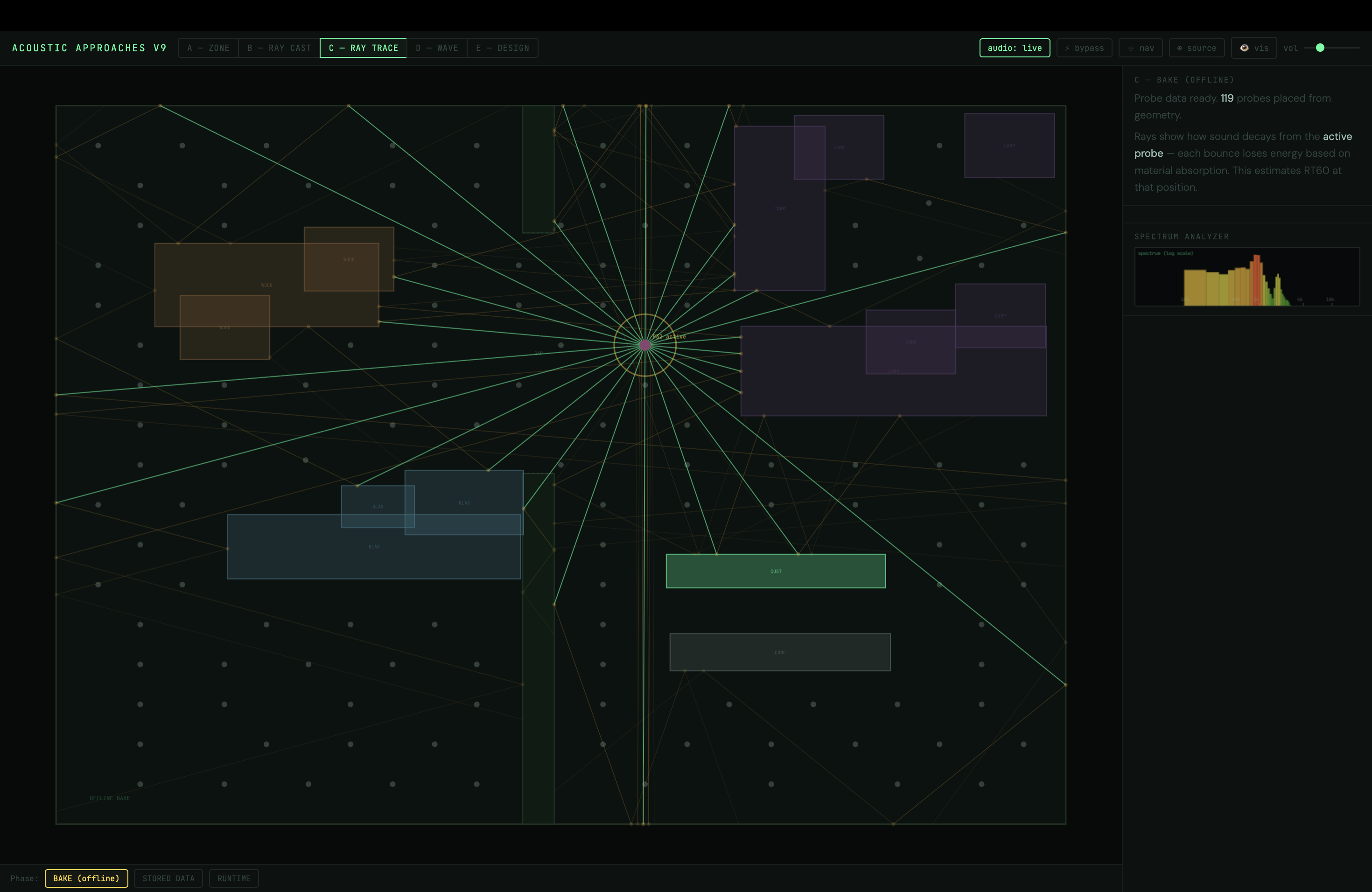
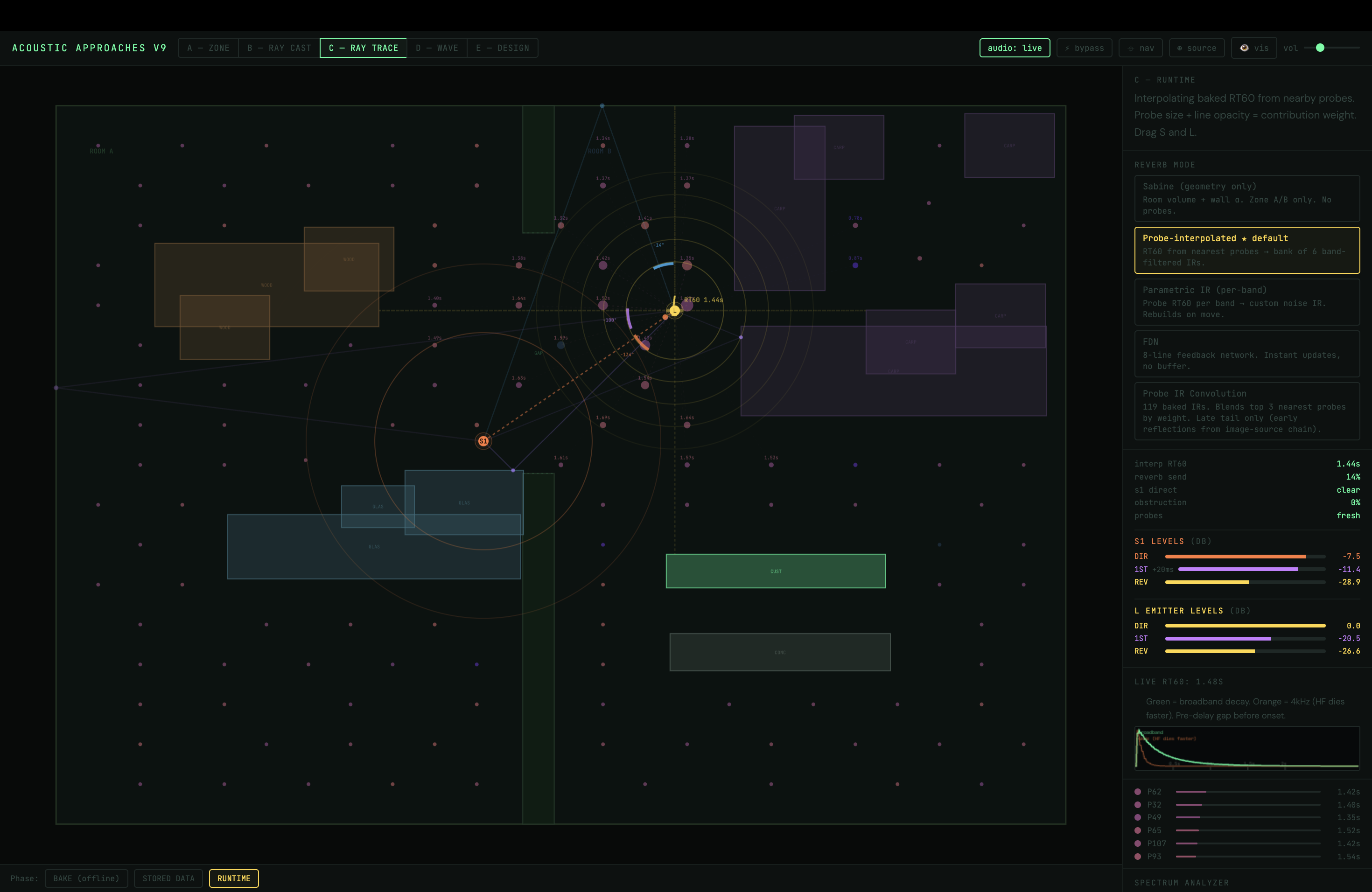
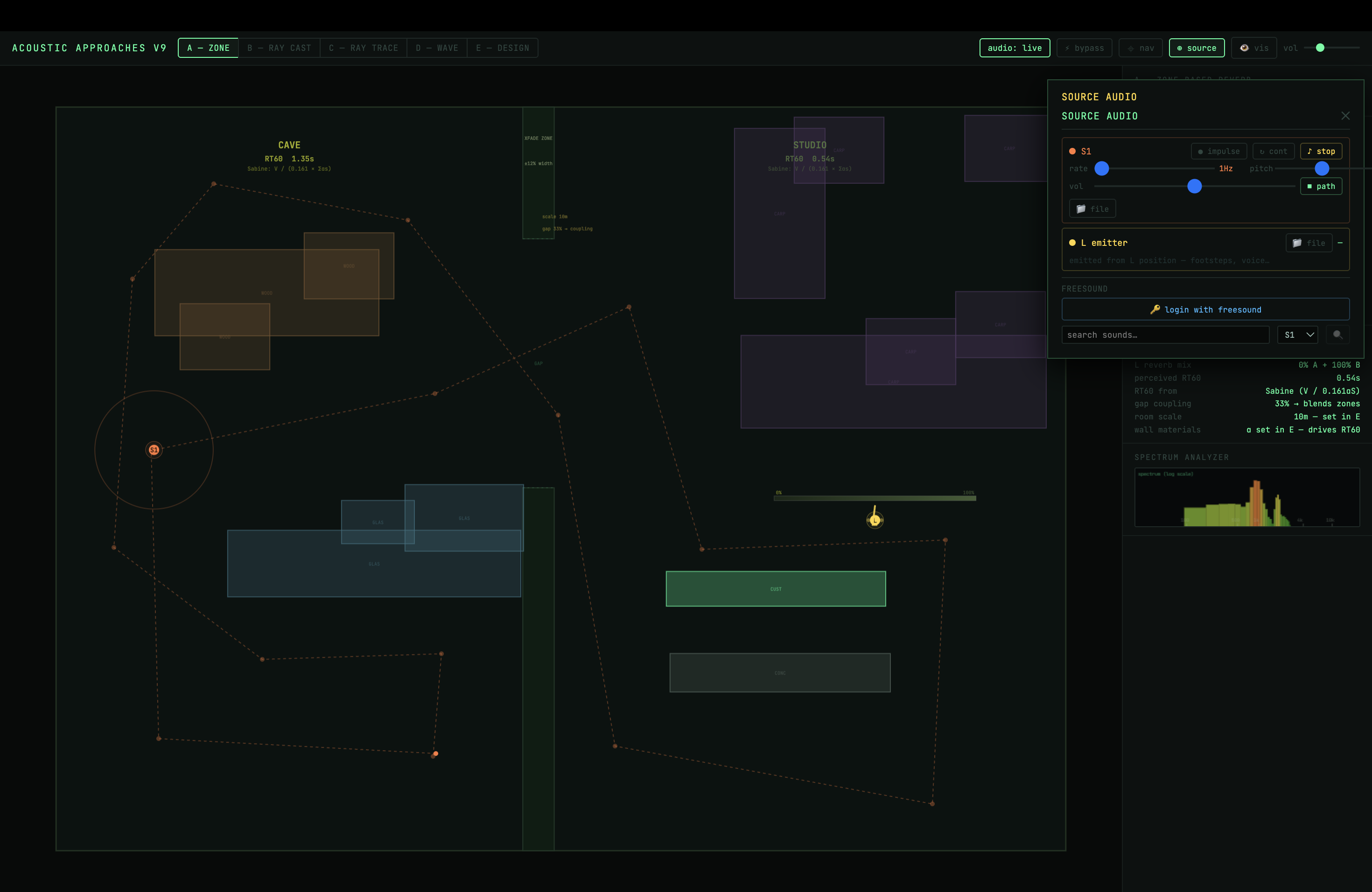
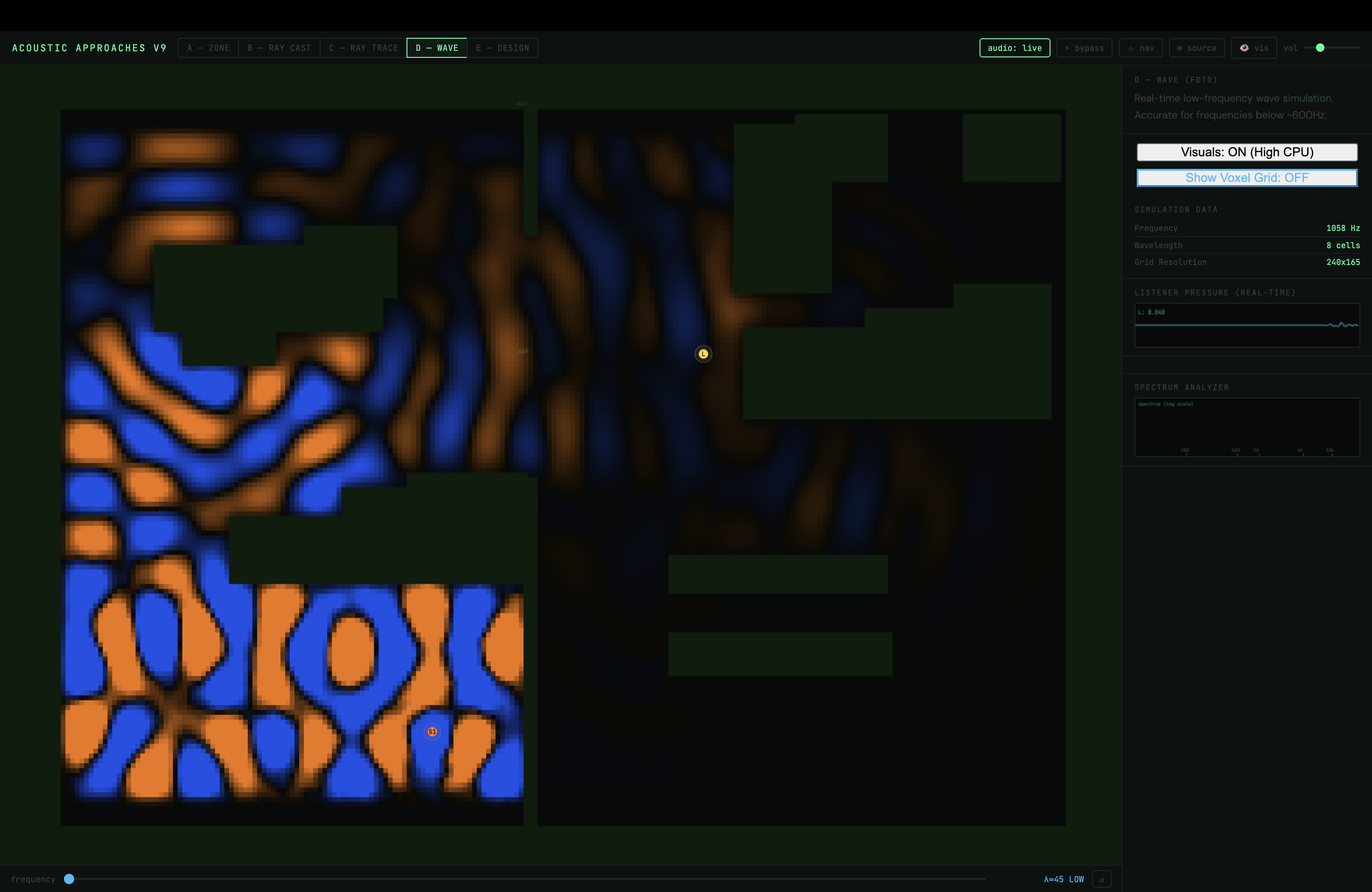
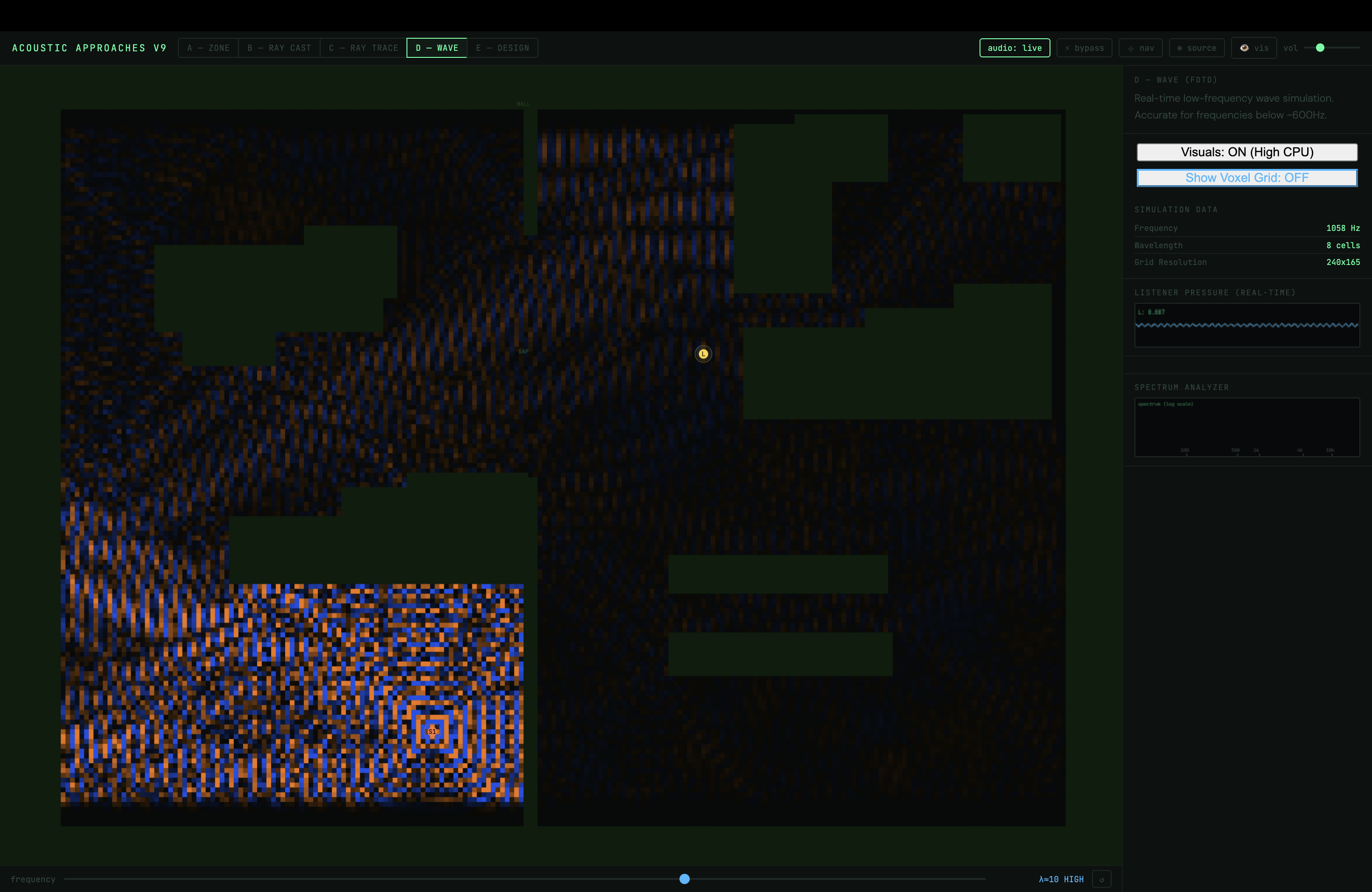
A spatial acoustic simulation tool I'm building with AI-assisted coding. A sandbox for understanding how different acoustic propagation approaches actually work - geometric acoustics, wave simulation, occlusion, early reflections - by implementing simplified versions of them rather than just reading about them.
The four approaches each model sound differently. Geometric acoustics treats sound like light - firing rays from a source, bouncing them off surfaces, and checking whether they reach the listener. Fast and dynamic, but it misses anything that requires sound to actually behave like a wave. Wave simulation solves the actual physics, capturing diffraction around corners and low-frequency room behavior that geometric methods can't, but it's expensive enough that it almost always has to be pre-computed offline. Occlusion checks is there something between the source and the listener, and if so, how much does it block? Early reflections are the first few bounces that reach the listener before the reverb tail - the part of room acoustics most responsible for our sense of space and distance.
The tool visualizes a handful of these - ray paths, reflection paths, zone boundaries. A simplification of a simplification, really. What we actually hear is the aggregated result of thousands of these interactions happening simultaneously, so the visualization is more useful as a mental model than as a faithful representation of acoustic reality.
I've spent years working with proprietary audio tools where the underlying systems were designed long before I arrived. You learn what they can do, what they can't, but the why stays hidden behind the interface and undocumented design choices. Building your own crude versions of these things is teaching me more than documentation ever did.
What's been most revealing is the edge cases. The gap between what's mathematically accurate and what actually works perceptually is wider than you'd expect. A solution can be physically correct and sound wrong. Another can be a crude approximation and sound completely convincing -- a single low-pass filter on an occluded source often sounds more believable than a physically correct diffraction calculation. I knew this from working with other tools, but now it's clearer than ever.
Still very much in progress. More about the questions it raises than the tool itself. If it proves to be a reliable learning tool I might actually share it.
Further reading
- Steam Audio - open source geometric baking and raycast system by Valve, good reference for seeing how a real implementation handles these problems
- Project Acoustics - Microsoft Research's wave simulation baking pipeline, the contrast case to geometric methods; ships in Gears of War 5, Sea of Thieves, Hellblade II
- Real-time Sound Propagation in Splinter Cell Blacklist - Ubisoft GDC talk on a lightweight obstruction/occlusion system, practical example of geometric acoustics in